
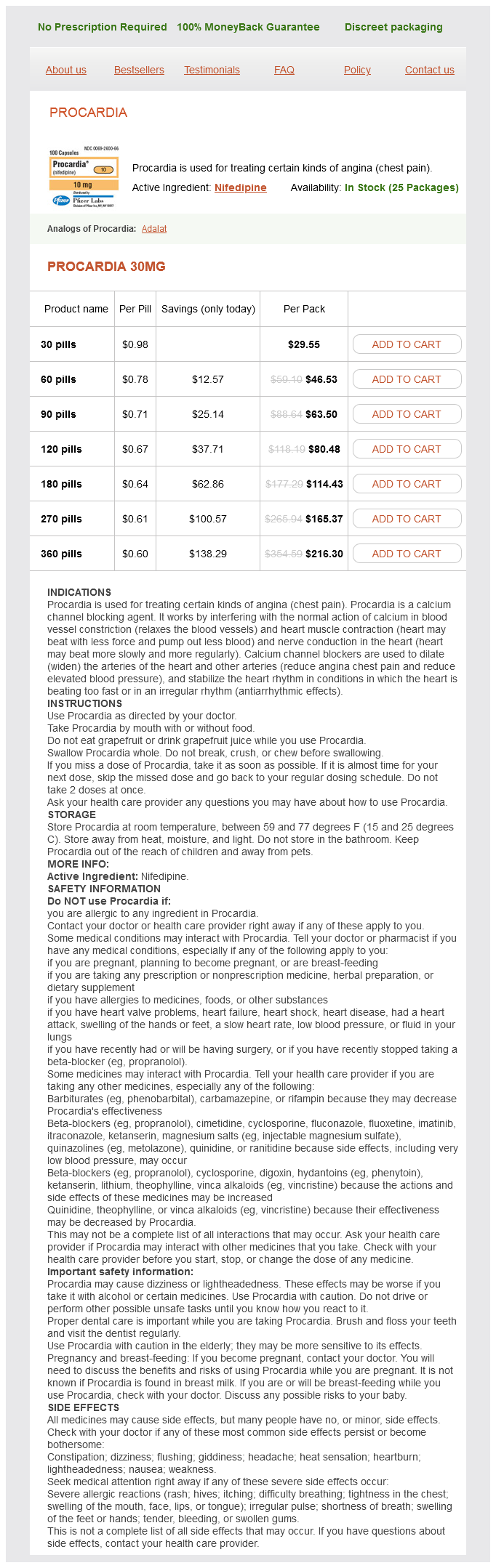
Procardia 30mg
- 30 pills - $29.55
- 60 pills - $46.53
- 90 pills - $63.50
- 120 pills - $80.48
- 180 pills - $114.43
- 270 pills - $165.37
- 360 pills - $216.30
Procardia dosages: 30 mg
Procardia packs: 30 pills, 60 pills, 90 pills, 120 pills, 180 pills, 270 pills, 360 pills
In stock: 975
Only $0,64 per item
Description
Nephrotoxicity in bone marrow transplant recipients receiving aminoglycoside plus cyclosporine or aminoglycoside alone arteries near the temple procardia 30 mg cheap with amex. Whole-genome sequencing of gentamicin-resistant Campylobacter coli isolated from U cardiovascular system function assessment and therapeutic measures 30 mg procardia generic free shipping. The use of gentamicin in urinary tract infections with special reference to drug levels in complicated (urological) infections clogged arteries 20s procardia 30 mg. An analysis of gentamicin susceptibility of Neisseria gonorrhoeae isolates in Europe capillaries exchange food oxygen and procardia 30 mg safe. Prevalence of antimicrobial resistance in enterococcus isolates in Australia, 2005: report from the Australian Group of Antimicrobial Resistance. Vancomycin acts synergistically with gentamicin against penicillin-resistant pneumococci by rising the intracellular penetration of gentamicin. Gentamicin, a model new aminoglycoside antibiotic: clinical and laboratory studies in urinary tract an infection. Enterococcus faecalis infective endocarditis: a pilot examine of the connection between length of gentamicin remedy and end result. Adaptive resistance to aminoglycoside antibiotics from first-exposure downregulation. Carbapenemaseproducing Klebsiella pneumoniae bloodstream infections: reducing mortality by antibiotic mixture schemes and the position of carbapenems. Effect of selective decontamination on antimicrobial resistance in intensive care items: a scientific review and meta-analysis. Plasmids mediating resistance to gentamicin and different antibiotics in Enterobacteriaceae from four hospitals in Melbourne. Pharmacokinetics of gentamicin at traditional versus high doses: implications for once-daily aminoglycoside dosing. Selective digestive tract decontamination and selective oropharyngeal decontamination and antibiotic resistance in sufferers in intensive-care units: an open-label, clustered group-randomised, crossover study. Bacterial activity of antibiotics in opposition to Legionella micdadei (Pittsburg pneumonia agent). Bacteriological outcome � of combination versus single-agent treatment for staphylococcal endocarditis. Reproducibility research of the pharmacokinetics of amikacin, gentamicin and tobramycin: a three-way crossover examine. High-level resistance to gentamicin in scientific isolates of Streptococcus (Enterococcus) faecium. Antibiotic treatment of infections as a outcome of carbapenem-resistant Enterobacteriaceae: systematic analysis of the available evidence. Factors affecting duration of in-vivo postantibiotic effect for aminoglycosides towards gram-negative bacilli. In vitro activity of 18 antimicrobial brokers towards clinical isolates of Acinetobacter spp. Ampicillin plus ceftriaxone is as effective as ampicillin plus gentamicin for treating Enterococcus faecalis infective endocarditis. Aminoglycoside-modifying enzymes in medical isolates harboring extended-spectrum beta-lactamases. Inhibition of candidacidal exercise of human neutrophil leukocytes by aminoglycoside antibiotics. Ototoxicity in neonates handled with gentamicin and kanamycin: results of a four-year managed follow-up study. Transferable plasmid mediating resistance to multiple antimicrobial agents in Klebsiella pneumoniae isolates in Greece. Subacute enterococcal endocarditis: medical, pathologic, and therapeutic consideration of 33 circumstances. Selection of aminoglycoside-resistant variants of Pseudomonas aeruginosa in an in vitro mannequin. Nosocomial multiply resistant Klebsiella pneumoniae: epidemiology of an outbreak of apparent index case origin. Aminoglycoside resistance and aminoglycoside utilization: ten years expertise in a single hospital. Gentamicin remedy for sepsis as a end result of carbapenem-resistant and colistin-resistant Klebsiella pneumoniae. Prospective comparative research of variable dosage and variable frequency regimens for administration of gentamicin. Comparison of Enterococcus raffinosus with Enterococcus avium on the basis of penicillin susceptibility, penicillin-binding protein analysis, and high-level aminoglycoside resistance. Antimicrobial activities of beta-lactam antibiotics and gentamicin in opposition to penicillin-susceptible and penicillin-resistant pneumococci. The comparative activity of aminocyclitol antibiotics against 773 cardio Gram-negative rods and staphylococci isolated from hospitalized sufferers. Pharmacological differences between as quickly as every day and twice day by day gentamicin dosage in newborns with suspected sepsis. Clearance of gentamicin throughout hemodialysis: comparability of 4 synthetic kidneys. Molecular characterisation of high-level gentamicin-resistant enterococci from bloodstream infections in Denmark: first description of clonal unfold of aph(2)-Ib. Klebsiella neonatal infections: mechanism of broadening aminoglycoside resistance. Anaerobic resistance of scientific isolates of Staphylococcus aureus to aminoglycosides. Predicted and measured aminoglycoside pharmacokinetic parameters in critically sick patients. Is there a role for monotherapy with betalactam antibiotics within the initial empirical administration of febrile neutropenic most cancers sufferers Nationwide surveillance of bacterial pathogens from sufferers with acute uncomplicated cystitis carried out by the Japanese surveillance committee during 2009 and 2010: antimicrobial susceptibility of Escherichia coli and Staphylococcus saprophyticus. Selection of resistance to gentamicin and netilmicin within the faecal flora following prophylaxis for colo-rectal surgical procedure. Cochlear neural degeneration without hair cell loss in two sufferers with aminoglycoside ototoxicity. Characterization of the gentamicin resistance transposon Tn5281 from Enterococcus faecalis and comparison to staphylococcal transposons Tn4001 and Tn4031. Central nervous system toxicity of intraventricularly administered gentamicin in adult rabbits. High-level, plasmid-borne resistance to gentamicin in Streptococcus faecalis subsp. Combination antibiotic remedy versus monotherapy for Pseudomonas aeruginosa bacteraemia: a metaanalysis of retrospective and prospective research. Prevalence of plasmid-mediated quinolone resistance and aminoglycoside resistance determinants among carbapenem non-susceptible Enterobacter cloacae. Calcium is a competitive inhibitor of gentamicin-renal membrane binding interactions and dietary calcium supplementation protects against gentamicin nephrotoxicity. Decolonization of intestinal carriage of extended-spectrum -lactamase-producing Enterobacteriaceae with oral colistin and neomycin: a randomized, doubleblind, placebo-controlled trial. Bacteremia caused by hemolytic, high-level gentamicin-resistant Enterococcus faecalis. Nonparametric strategy to population pharmacokinetics in oncology patients receiving aminoglycoside therapy. Postantibiotic effect of aminoglycosides on Gram-negative micro organism evaluated by a new method. Ototoxicity of gentamicin in man: a survey and managed analysis of scientific experience within the United States. Structural and phenotypic sorts of gentamicin resistance plasmids in hospital strains of Staphylococcus aureus and coagulase-negative staphylococci. Interaction of gentamicin with the A band and B band lipopolysaccharides of Pseudomonas aeruginosa and its possible deadly effect. Longstanding post-therapeutic gentamicin serum and urine concentrations in patients with unimpaired renal perform. Postantibiotic impact in Pseudomonas aeruginosa following single and multiple aminoglycoside exposures in vitro. Optimizing aminoglycoside remedy for nosocomial pneumonia brought on by Gram-negative micro organism.
Thyme Essential Oil (Thyme). Procardia.
- Are there any interactions with medications?
- Are there safety concerns?
- Dosing considerations for Thyme.
- How does Thyme work?
- Bronchitis, in combination with cowslip; treating hair loss (alopecia areata) when combined with other herbs; improving movement disorders in children when used with other medicines; colic; ear infections; swelling (inflammation) of the tonsils; preventing bedwetting; sore throat; bad breath; bronchitis; and swelling (inflammation) of the lungs and mouth.
- What is Thyme?
Source: http://www.rxlist.com/script/main/art.asp?articlekey=96799
Simulation confirmed that the optimum dosing schedule is 30 mg/kg per day heart disease 90 blockage procardia 30 mg cheap with visa, irrespective of gesta tional age coronary heart 7 point 30 mg procardia purchase with amex, in three doses heart disease xiphoid process 30 mg procardia generic visa. Serum level monitoring on 11 different patients confirmed that there was no evidence of accumulation with repeated doses capillaries characteristics procardia 30 mg trusted. Vancomycin may be added to peritoneal dialysis fluid and administered intraperitoneally. The half life for equilibration of vancomycin into the circulation from the dialysate is 2. In effect, a 2 g dose of vancomycin given intraperitoneally over a 4hour dwell interval is equiva lent to a 1. With decrease intraperitoneal doses, corresponding to these used when peritoneal dialysisassociated peritonitis is handled by add ing vancomycin to every dialysis bag, a lot lower levels are obtained: a upkeep dose of 25 mg/l leads to a serum degree of zero. Drug distribution Vancomycin diffuses readily into pleural, pericardial, ascitic, and synovial fluids (Geraci et al. Vancomycin ranges in lung epithelial lining fluid obtained by bronchoalveolar lavage averaged 4. In a study of publish mortem tissues from a affected person treated with vancomycin until the time of dying, good concentrations have been discovered in the kidney, liver, lung, heart and aorta, and in an abscess (Torres et al. Vancomycin penetrates satisfactorily into medi astinal and cardiac tissues when given as a 15 mg/kg preop erative dose (with or without a supplemental 7. Bone penetration has been investigated in 19 sufferers, 5 of whom had osteomyelitis, and adequate cancellous and cortical levels had been obtained in most specimens (Graziani et al. However, solely 6 of 13 women acquired the complete 1 g vancomycin dose, because the opposite 7 had some manifestation of "pink man syndrome" during the infusion (see part 6, Toxicity). Cord vancomycin concentrations approached maternal serum con centrations four hours after the infusion ended (Laiprasert et al. Vancomycin is excreted in human breast milk, although no quantitative data are available. The bactericidal actions of vancomy cin in opposition to two reference strains and two medical isolates of S. Mono exponential and biexponential killing curves for vancomycin over a 2�50 g/ml concentration vary were generated for 11 S. Initial vancomycin concentrations of 5, 10, 20, and 40 g/ml have been studied mon oexponentially while simulating a 6hour halflife. However, vancomycin was less rapidly bactericidal than cloxacillin in vivo (Fernandez Guerrero and de Gorgolas, 2006). Van comycin regimens of 1 g each 12 hours and a pair of g every 12 hours got over 72 hours. Pharmacokinetics and pharmacodynamics 805 vancomycin may occur with strains of S. These had been grownup sufferers who acquired vancomycin and had a measured serum con centration throughout the first seventy two hours of therapy. Univariate and multivariate analyses had been used to assess variables pre dictive of inhospital mortality. In complete, seventy six sufferers had been enrolled; vancomycin treatment failure occurred in 20 sufferers (26. Nephrotoxicity occurred only in the hightrough concentration group (11/63; 12%), significantly predicted by concomitant remedy with different nephrotoxic brokers. For continuousinfusion vancomycin, totally different regular state goal ranges have been proposed over the previous decade. Several administration protocols and nomograms validated in a quantity of affected person cohorts are avail ready. They used completely different loading doses and in addition used diverse every day doses, for which calculations have been based mostly on estimates of CrCl by the CockcroftGault method, to obtain goal 6. Adverse reactions and toxicity 807 steadystate concentrations of 25 �g/ml (Jeurissen et al. All of those schemes had been developed in samples of critically unwell patients, so imple mentation in different sufferers might require closer monitoring (Hanrahan et al. Special consideration is required for pediatric populations, as a result of dosing varies with a number of options, including gesta tional age, weight, and comorbidities. Simulations were performed to have the ability to consider current dosing regimens and to suggest a modelbased dosing algo rithm. Both the neonatal and pediatric fashions of vancomycin carried out properly in the external information sets, resulting in concentrations that were predicted correctly and without bias. For neonates, a dosing algorithm based mostly on body weight at birth and postnatal age was proposed, with every day doses divided over three to four doses. For infants aged < 1 yr, doses between 32 and 60 mg/kg/day over four doses were proposed, whereas at more than 1 yr of age, 60 mg/ kg/day seemed acceptable. Drug interactions Coadministration of vancomycin with anesthetic agents may be related to erythema and histamine�like flushing and anaphylactoid reactions. Concurrent and/or sequential use of potentially neurotoxic and/or nephrotoxic drugs, similar to amphotericin B, aminoglycosides, bacitracin, polymyxin B, colistin, viomycin, or cisplatin, requires careful monitoring. Major incompatibilities with vancomycin have been ob served with betalactams (temocillin, piperacillin/tazobactam, ceftazidime, imipenem, cefepime, and flucloxacillin) and moxifloxacin, but not with ciprofloxacin, aminoglycosides, and macrolides, when these medicine are coadministered in the identical intravenous line. Propofol, valproic acid, phenytoin, theophylline, methylprednisolone, and furosemide are also incompatible, whereas ketamine, sufentanil, midazolam, morphine, piritramide, nicardipine, urapidil, dopamine, dobutamine, and adrenaline seem suitable. No effect or incompatibility with Nacetylcysteine or amino acid solu tions has been detected. Thus, a number of drugs require distinct intravenous traces or appropriate procedures to avoid undue contact and potential interaction (Raverdy et al. Extrarenal (possibly hepatic) excretion of vancomycin might happen to a small extent, as a outcome of comparatively high vancomycin clearances are observed in patients with compromised renal function (Rotschafer et al. This response includes any mixture of skin itch, pores and skin flush ing (most prominently over the upper body), angioedema, hypotension, tachycardia, and infrequently muscle aches. The reaction usually begins roughly half-hour after the infusion has began, with sufferers complaining of itching and heat over the top and chest. The reaction might start to abate even as the infu sion is continued, and virtually always resolves utterly inside 1 hour of completion of the infusion. The redman syndrome is believed to end result from van comycininduced histamine launch (Polk et al. Several studies have demonstrated a correlation between the levels or fee of manufacturing of histamine and the prevalence of redman syn drome in wholesome volunteers. Pretreatment with antihistamines can reduce the fre quency of redman syndrome; only 8% of wholesome volunteers developed the reaction after medication with an H1 antago nist (hydroxyzine), in contrast with 92% of placebo recipients. A similar protecting effect with antihistamines has also been reported in patients handled with vancomycin (Wallace et al. However, not all studies have supported a relationship between histamine release and redman syndrome (Rybak et al. Combining the results of six studies, a hanging fifty eight of 66 wholesome grownup volunteers receiving a 1 g i. Reactions may be much less widespread in patients for the following reasons: previous administration of antihistamines for different purposes, depletion of histamine shops in response to acute an infection or from previous use of narcotics, or greater difficulty in rec ognizing the syndrome in sick patients. The dose of vancomycin and its price of infusion have an effect on the frequency of redman syndrome. Similarly, when one thousand mg of vancomycin was infused over 2 hours rather than 1 hour to 10 wholesome volunteers, the number of volunteers developing reactions fell from eight with the shorter infusion to three with the longer infusion (Healy et al. The incidence of redman syndrome is highest with the primary dose of vancomycin and falls with subsequent doses. Redman syndrome is much much less frequent with the other glycopeptide antibiotic teicoplanin (Sahai et al. If a affected person develops redman syndrome, the infusion time must be extended to 2 hours and pretreatment with an antihistamine could additionally be considered. Successful vancomycin desen sitization has been reported, however will not be particularly rel evant for this syndrome compared to true allergy (Lin, 1990; Wong et al. Hypotension is rare when vancomycin is infused over 60 minutes, but it was reported in eleven of 25 patients given vancomycin 1 g over 10 minutes preopera tively (Newfield and Roizen, 1979). When vancomycin has been administered more slowly (over 30�60 minutes) both earlier than or after the induction of anesthesia, no significant adjustments in heart fee or blood strain have been famous in other research (Rosen berg et al. Preoperative and intraoperative adminis tration of vancomycin seems to be secure, provided that the drug is infused over 30�60 minutes, but potentiation of the hypotensive effect of vancomycin by anesthetic brokers being given on the same time can happen. True allergic vancomycin reactions, mediated by IgE, are quite unusual, however they do happen.
Specifications/Details
Self-reported adverse occasions associated with antimalarial chemoprophylaxis in peace corps volunteers cardiovascular lynchburg va order 30 mg procardia free shipping. Final report of the Lyme disease evaluate panel of the Infectious Diseases Society of America 310 capillaries 30 mg procardia generic with visa. Azithromycin versus doxycycline for genital chlamydial infections: a meta-analysis of randomized scientific trials cardiovascular disease costs associated with uncontrolled hypertension 30 mg procardia best. Distribution of systemic ciprofloxacin and doxycycline to gingiva and gingival crevicular fluid blood vessels under the greatest pressure purchase procardia 30 mg overnight delivery. Therapeutic impact of the correlation of doxycycline serum concentrations and the decline of part I antibodies in Q fever endocarditis. Treatment of pneumococcic meningitis with penicillin in contrast with penicillin plus aureomycin; studies including observations on an obvious antagonism between penicillin and aureomycin. Molecular epidemiology and antimicrobial susceptibility profiles of methicillinresistant Staphylococcus aureus blood culture isolates: outcomes of the Quebec Provincial Surveillance Programme. Q fever pneumonia within the Negev region of Israel: a review of 20 sufferers hospitalised over a period of one year. Antibiotic-resistant Propionibacterium acnes among pimples patients in a regional pores and skin centre in Hong Kong. The effect of antibiotic treatment on lively trachoma and ocular Chlamydia trachomatis infection. The elimination of tritiated doxycycline in regular topics and in patients with severely impaired renal perform. Studies on the absorption and distribution of doxycycline in normal sufferers and in patients with severely impaired renal operate. Serum doxycycline ranges after intravenous administration in haemodialysis sufferers. Standard therapy regimens for nongonococcal urethritis have similar but declining remedy rates: a randomized controlled trial. Sputum and plasma doxycycline concentrations after a single oral 600 mg doxycycline dose in patients with continual bronchitis. Activities of gemifloxacin and five other antimicrobial agents against Listeria monocytogenes and coryneform micro organism isolated from clinical samples. Synergy testing of vancomycin-resistant Enterococcus faecium in opposition to quinupristin�dalfopristin in combination with other antimicrobial brokers. Phagolysosomes of Coxiella burnetii�infected cell strains preserve an acidic pH during persistent infection. Drug-resistant malaria in Bangui, Central African Republic: an in vitro assessment. Antimicrobial susceptibility of Propionibacterium acnes isolates from pimples sufferers in Colombia. Black thyroid ensuing from short-term doxycycline use: case report, evaluation of the literature, and discussion of implications. Immunoglobulin G anticardiolipin antibodies and progression to Q fever endocarditis. Evolution from acute Q fever to endocarditis is related to underlying valvulopathy and age and can be prevented by prolonged antibiotic remedy. Antimicrobial susceptibility testing of Bacillus anthracis: comparability of outcomes obtained by using the National Committee for Clinical Laboratory Standards broth microdilution reference and Etest agar gradient diffusion methods. In vitro susceptibility of pathogenic Vibrio species to norfloxacin and six other antimicrobial brokers. Use of doxycycline to lower the growth rate of stomach aortic aneurysms: a randomized, double-blind, placebo-controlled pilot research. Treatment of plague with gentamicin or doxycycline in a randomized scientific trial in Tanzania. Prophylaxis with singledose doxycycline for the prevention of Lyme illness after an Ixodes scapularis tick bite. The effect of doxycycline on serum ranges of ethinyl estradiol, norethindrone, and endogenous progesterone. Pharmacokinetics of oral doxycycline throughout mixture treatment of severe Falciparum malaria. Effect of oral antacid administration on the pharmacokinetics of intravenous doxycycline. In vitro susceptibility of Stenotrophomonas maltophilia isolates: comparability of disc diffusion, Etest and agar dilution strategies. Treatment of early seropositive rheumatoid arthritis: doxycycline plus methotrexate versus methotrexate alone. Mefloquine in contrast with doxycycline for the prophylaxis of malaria in Indonesian soldiers. The concentration of doxycycline in human prostate gland and its position within the remedy of prostatis. Synergy tests by E test and checkerboard methods of antimicrobial combos towards Brucella melitensis. Ehrlichia-induced hemophagocytic lymphohistiocytosis: A case Series and Review of literature. Antibiotic remedy of louse-borne relapsing fever in Ethopia: a report of 377 cases. Doxycycline inhibition of aneurysmal degeneration in an elastase-induced rat mannequin of abdominal aortic aneurysm: preservation of aortic elastin related to suppressed production of 92 kD gelatinase. Intravenous therapy period and outcomes in melioidosis: a model new therapy paradigm. Bacteraemia and pelvic an infection in girls as a result of Ureaplasma urealyticum and Mycoplasma hominis. In vitro results of doxycycline and tetracycline on mitogen stimulated lymphocyte progress. Antibiotics for prophylaxis of Plasmodium falciparum infections: in vitro activity of doxycycline towards Senegalese isolates. Effects of doxycycline in actively purging cholera sufferers: a double-blind scientific trial. In vitro antibiotic susceptibility of Rickettsia rickettsii and Rickettsia conorii: plaque assay and microplaque calorimetric assay. Shell-vial assay: analysis of a new method for determining antibiotic susceptibility, examined in thirteen isolates of Coxiella burnetii. Unravelling mysteries associated with catscratch illness, bacillary angiomatosis, and associated syndromes. Imipenem, doxycycline and amikacin in monotherapy and in combination in Acinetobacter baumannii experimental pneumonia. Modulation of melanogenesis and antioxidant status of melanocytes in response to phototoxic aAction of doxycycline. Culture and antibiotic susceptibility of Bartonella quintana in human erythrocytes. Reevaluation of Clinical and Laboratory Standards Institute disk diffusion breakpoints for tetracyclines for testing Enterobacteriaceae. Antimicrobial susceptibility and genetic characteristics of Propionibacterium acnes isolated from sufferers with zits. In vitro actions of fourteen antimicrobial brokers against obligately anaerobic bacteria. High prevalence of genital mycoplasmas among sexually energetic young adults with urethritis or cervicitis signs in La Crosse, Wisconsin. Activities of telithromycin, erythromycin, fluoroquinolones, and doxycycline against Campylobacter strains isolated from Finnish subjects. Pharmacokinetics of lymecycline and doxycycline in serum and suction blister fluid. Protection against endotoxic shock and lipopolysaccharide-induced native irritation by tetracycline: correlation with inhibition of cytokine secretion. Failure of doxycycline as a causal prophylactic agent against Plasmodium falciparum malaria in wholesome nonimmune volunteers. Comparative randomized pilot study of azithromycin and doxycycline efficacy in the treatment of prostate an infection attributable to Chlamydia trachomatis. Comparative randomized pilot research of azithromycin and doxycycline efficacy and tolerability in the treatment of prostate an infection caused by Ureaplasma urealyticum. Randomised, blinded, placebo controlled trial of doxycycline for chronic seronegative arthritis.
Syndromes
- Absent or extra kidney, and other problems with kidney or bladder
- Cancerous bone tumors (osteosarcoma, Ewing sarcoma)
- Type B
- Nuclear stress test
- Meningitis
- Size and characteristics of the polyps
Related Products
Additional information:
Usage: q.d.
Tags: discount 30 mg procardia with amex, procardia 30 mg purchase online, buy procardia 30 mg otc, procardia 30 mg generic, 30 mg procardia generic mastercard, generic procardia 30 mg line, cheap procardia 30 mg overnight delivery, purchase procardia 30 mg visa, 30 mg procardia discount otc, procardia 30 mg buy fast delivery, discount procardia 30 mg on-line, 30 mg procardia discount free shipping, 30 mg procardia best, procardia 30 mg order online, purchase 30 mg procardia with amex, buy 30 mg procardia amex
8 of 10
Votes: 259 votes
Total customer reviews: 259
Customer Reviews
Delazar, 39 years: In vitro susceptibility of Mycobacterium fortuitum and Mycobacterium chelonei to amikacin. Similar to other members of the tetracycline family, minocycline inhibits bacterial protein synthesis through its binding action on the bacterial 30S ribosomal subunits. One linezolid subject and two topics within the 400-mg tedizolid cohort who attained a predefined opposed occasion finish point had been discontinued from the examine.
Josh, 25 years: Specific analysis for daptomycin in each urine and plasma indicated that metabolic products have been present in urine, however whole carbon-14 in plasma consisted of daptomycin only (Woodworth et al. Human serum exercise of telithromycin, azithromycin and amoxicillin/clavulanate in opposition to frequent cardio and anaerobic respiratory pathogens. Patients who obtained vancomycin postdialysis maintained a mean serum concentration of 6.
Kaffu, 40 years: Among the 18 subjects within the three different dosing groups, superficial phlebitis (13 subjects) and nausea (11 subjects) were the most generally reported antagonistic occasions. Linezolid use for remedy of multidrug-resistant and extensively drug-resistant tuberculosis, New York City, 2000�06. In people, these antagonistic effects have been additionally lowered when once-daily dosing was administered.
Giores, 42 years: The minocycline bronchial mucus�plasma concentration ratios were much greater than what had been present in ordinary sputum samples reported in different studies (MacCulloch et al. Neurotoxicity and neuromuscular blockade Gentamicin, in widespread with different aminoglycosides, may cause neuromuscular blockade. The 79% mortality seen in patients handled with the penicillin�tetracycline combination was considerably greater than in sufferers handled with penicillin mono- 5d.