
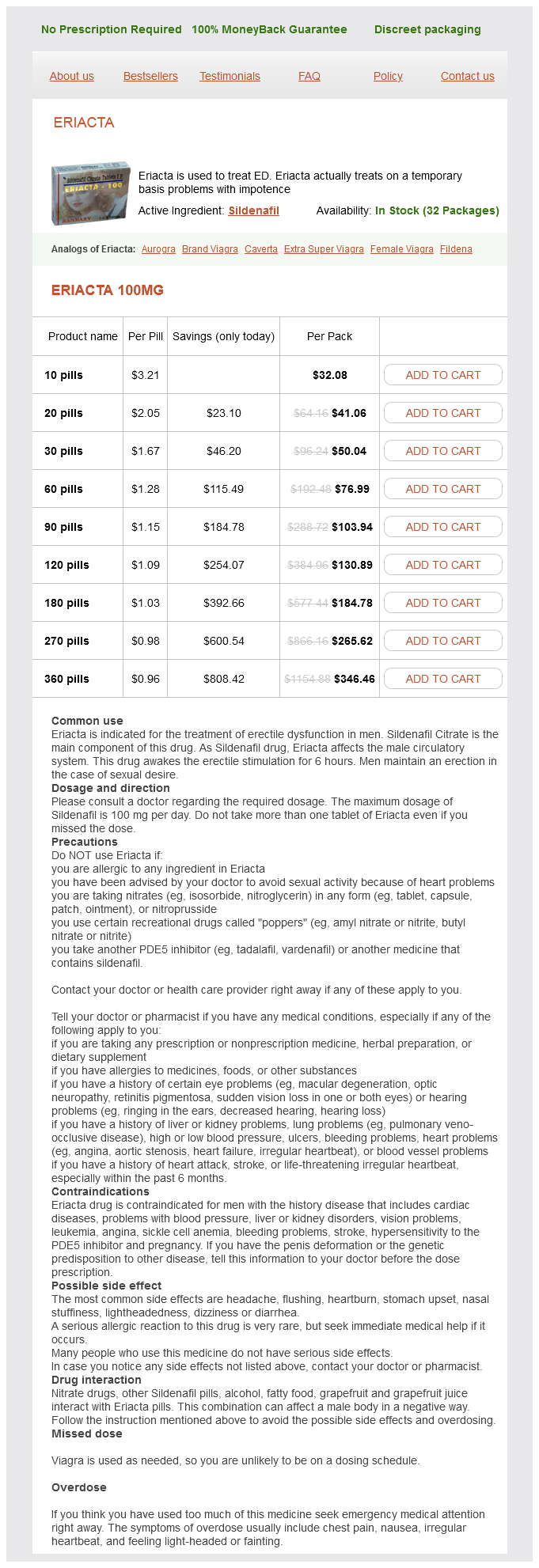
Eriacta 100mg
- 10 pills - $32.08
- 20 pills - $41.06
- 30 pills - $50.04
- 60 pills - $76.99
- 90 pills - $103.94
- 120 pills - $130.89
- 180 pills - $184.78
- 270 pills - $265.62
- 360 pills - $346.46
Eriacta dosages: 100 mg
Eriacta packs: 10 pills, 20 pills, 30 pills, 60 pills, 90 pills, 120 pills, 180 pills, 270 pills, 360 pills
In stock: 532
Description
Thus erectile dysfunction treatment sydney discount 100 mg eriacta mastercard, complete surgical resection with an enough margin of regular tissue is advocated erectile dysfunction see a doctor order 100 mg eriacta with amex. In the previous erectile dysfunction help without pills eriacta 100 mg generic, for the parotid gland erectile dysfunction pump treatment eriacta 100 mg discount with amex, this constituted a complete superficial parotidectomy. This procedure is outlined as any parotidectomy in which less than the whole lobe or less than all the branches of the facial netVe are dissected. Lower rates of facial netVe weakness and Frey syndrome are obsetVed with this method (9). Rarely, pleomorphic adenoma can metastasize and but remain benign appearing histologically. When feasible, surgical resection of the metastatic site is the optimal remedy. Salivary gland neoplasms in oral and maxillofacial areas: a 23-year retrospective study of 6982 cases in an japanese Chinese inhabitants. Clinical d:larac:tarirtics and survival for main salivary gland malignancies in youngsters. The frequency and distribution sample of minor salivary gland tumors in a gowmment dental teadling hospital, Chennai, India. Howevet extraparotid sites could be concerned as properly, sometimes within the cervical lymph nodes (12). Classically, it is a tumor that occurs extra generally in men, however the incidence has elevated in ladies. Cut sections reveal a number of cystic areas that c::an be filled with a thic::k, mucinous exudate. The epithelium is a double layer of oxyphilic:: granular cells, with cells of the inside layu having the nuclei oriented toward the basement membrane. The histologic appearanoe exhibits charac:t�rlstlc epithelial and mesanchymal Qlements. Oncocytoma Oncocytoma is an uncommon salivary gland tumor that accoWlts for about 1% ofall salivary gland neoplasms (15). This tumor happens most incessantly within the fifth and sixth a long time of life and with equal distribution between women and men (16). A mitochondria-filled cystoplasm is a characteriatic discovering on electron microscopy. A possible clarification for these tumors is an acquired genetic defect resulting in mitochondrial dysfunction; nonetheless, an exact molecular mechan. Basal Cell Adenoma Basal cell adenoma represents about 2% to 3% of all salivary gland tumors. It often happens within the sixth to seventh a long time of I~ and it oc::cu:rs most often within the parotid gland. The the rest are divided between the submandibular and the minor salivaJ:y glands. Finally, the membranous pattern consists of differing sizes of islands of basaloid cells. The membranous pattern can show multicentric tumor patterns and has a better rate of recurrence after surger:y (18). Mucoepidermoid cardnoma constitutes roughly 30% to 35% of all malignant tumors of the sali:vaJ:y glands (19,20). Mucoepidermoid carcinomas are normally categorized as low-grade or high-grade tumors. These lesions behave more like benign neoplasms but in rare circumstances are capable of native invasion and metastasis. High-grade tumors have a higher proportion ofepidermoid cells and could also be tough to differentiate from squamous cell cardnoma. Thus, the grade and stage of these neoplasms are essential prognostic variables (21). Cer:vical nodal metastases are managed by a complete neck dissection at the time of the resection of the primaxy. In most instances of high-grade mucoepidermoid cardnoma, adjuvant radiation therapy is really helpful to improve locoregional control (23). High-grade mucoepidermoid carcinoma is an aggressive tumor with a poorer prognosis than the low-grade variant. It is the second most typical malignancy of the parotid gland however is the most typical malignancy of the submandibular and minor salivary glands (25). Adenoid cystic carcinoma occurs with equal frequency in women and men, usually in the fifth. Facial paralysis and ache happen as initial symptoms in a small proportion of sufferers. Grossly, the tumor is often monolobular and both nonencapsulated or partially encapsulated. Different histologic patterns have been identified together with a1b:rifonn, stable, and tubular. Complete swgical excision and postoperative radiation therapy is remmmended for the administration of this tumor (27). Long-tmn follow-up is mandatmy for these patients because of the gradual, relenlless diaease progression. Acinic Cell Carcinoma Acinic cell carcinoma constitutes approximately 17% of all salivary gland cancers. The tumor could be multicentric in 2% to 5% of cases, and it could contain both parotid glands (32,33). Elective therapy of the neck ia indicated for high-gmde instances of acinic cell carcinoma (32). Long term follow-up is obligatory as a outcome of late local recurrences~ been shown to ocrur many years after initial treatment. For low-grade lesions, 5- and 10-year disease-free sumvab ~ been reported to be approximately 91% and 88%, respectively (34). Five-year ove:rall survival for high-grade acinic cell carcinoma is much poorer at 33% (33). Cervical metastases are very uncommon, so a neck dissection is carried out just for clinically optimistic nodes. Carcinoma Ex Pleomorphic Adenoma Caldnoma ex pleomorphic adenoma represents a malignant tumor that has males from a preexisting or recurrent pleomorphic adenoma the malignant component and metastases from this tumor are purely epithelial in origin. Rarely, the malignancy can take the shape in which the tumor incorporates each mesenchymal and epithelial components. The tumor can be categorized as noninvasive (in situ), minimally invasive (less than 1. The analysis may be confusing because of the differing proportions of benign and malignant parts of the Adenocarcinoma Adenocarcinoma most commonly occurs within the minor salivary glands adopted by the parotid gland 1his neoplasm represents approximately 12% of malignant parotid neoplasms (35). Adenocarcinomas ocrur equally in both sexes and usually current as a palpable mass. The diploma of glandular formation has been used as a method of grading these tumors. Complete surgical resection with postoperative radiation remedy is the beneficial remedy for this highgrade malignancy. Women are affected extra generally than males, and most of those neoplasms happen within the sixth decade of life. The typical presentation of this tumor is of a long-standing, asymptomatic mass on the palate (37). Typical histologic patterns include stable, trabeculat glandulat cribriform, fasciculat cord-like, and papillary. Because of this, cautious pathologic diagnosis is mandatory as this neoplasm can be mistaken for pleomorphic adenoma or adenoid cystic carcinoma. Elective therapy of the neck is beneficial as a result of rates of occult metastases have been proven to be about 20%. Other prognostic components embrace pathologic stage, tumor size, grade, proportion of cane~ and extent of invasion (41).
Bidhara (Hawaiian Baby Woodrose). Eriacta.
- How does Hawaiian Baby Woodrose work?
- Are there safety concerns?
- Dosing considerations for Hawaiian Baby Woodrose.
- Pain relief and promoting sweating.
- Are there any interactions with medications?
- What is Hawaiian Baby Woodrose?
Source: http://www.rxlist.com/script/main/art.asp?articlekey=96344
D: Post-op panoramic radiograph reveals reconstruction with an lilac mast bone graft severe erectile dysfunction causes eriacta 100 mg generic free shipping. D Histopllthology Thrtuous endothelium-lined erectile dysfunction organic eriacta 100 mg purchase mastercard, dilated vessels comprise the microscopic look of this situation erectile dysfunction drugs prostate cancer buy 100 mg eriacta otc. Hypotensive anesthesia may also be used to additional reduce inttaoperative bleeding erectile dysfunction heart disease buy 100 mg eriacta with amex. Venous malformations can be treated with coils or inttalesional injections of sclerosing brokers. Arterial malformations are handled with preoperative selective embolization adopted by resection surgical procedure. The function of embolization is to limit the blood:flow to the lesion in order to decrease blood loss when the lesion is excised. Some of the cysts and tumors possess domestically aggressive habits and are able to great tissue distortion and/or destruction. Thus, they current challenges relating to their treatment and ultimate reconstruction. Marsupialization as a definitive therapy for odontogenic Keratocysts, J Oral Max~1lofac Surg 2004; sixty two: 651-2004. Odontogenic keratocysts: a scientific and histologic comparability of the parakeratin and orthokeratin variants. The odontogenic keratocyst and its occurrence within the nevoid basal cell cardnoma syndrome. Peripheral ameloblastoma: biological profile primarily based on one hundred sixty instances from the literature. Calcifying epithelial odontogenic tumour: biologic profile primarily based on 181 instances from the literature. Orsini G, Favia G, Piattelli A Peripheral clear cell calcifying epithelial odontogenic tumor: report of a case. Caldfying epithelial odontogenic tumor displaying microscopic features of potential malignant habits. Relative inddence of odontogenic tumors and oral and jaw cysts in a Canadian population. Early delicate tissue pathosis assodated with impaaed third molars without pericoronal radiolucency. Buchner A the central (inttaosseous) calcifying odontogenic cyst an analysis of 215 cases. Central giant cell lesions of the mandible and maxilla: a clinicopathologic and cytometric study. Treatment of a high-flow arteriovenous malformation by direct puncture and coil embolization. Osteochondroma of the mandibular condyle: literature review and report of two atypical circumstances. Ferris It is estimated that 45,000 new cases of thyroid most cancers have been identified and 1,690 of them will die of this disease in 2010 (1,2). This development could also be as a outcome of increasing use of neck ultrasound in addition to different imaging modalities during routine physical examination. The problem exists to establish the 5% to 10% of sufferers with malignancy of scientific significance. The diagnosis and remedy of thyroid cancer have considerably developed over final decade, emphasizing the need for an intensive understanding of the underlying molecular pathways and risk elements, in addition to the surgical anatomy, diagnostic, and treatment algorithms essential to provide glorious look after patients with thyroid neoplasm. The medial portion of the gland derives from the endodermal diverticulum of the primary and second pharyngeal pouches on the foramen cecum. It then descends to its pretracheal place alongside the midline neck during four to 7 weeks of gestation, and the proximal portion degenerates right into a fibrous stalk. The lateral portion of the gland derives from the fourth and fifth pharyngeal pouches, which descend to fuse with the medial portion of the gland. Parafollicular C cells originate from the ectoderm neural crest cells because the ultimobranchial physique, which secretes calcitonin. In mammals, the ultimobranchial body and medial portion of the fourth pharyngeal fuse into the lateral lobes of the thyroid. Ectopic thyroid tissue may be discovered wherever along the course of its developmental descent in the midline anterior neck. Lingual thyroid can be found at its origin on the foremen cecum because of failure to descend. It might develop at any location along the thyroglossal duct tract, most commonly on the midline upper cervical location near the hyoid bone. The scientific presentation differs considerably when it comes to the size, extent of the cane~ the presence and the variety of lymph node metastases, and response to the remedy (6). It is nicely established that exposure to ionizing radiation to the head and neck area throughout childhood will increase the chance of thyroid cancer. The 25-year follow-up after the Chemobyl accident demonstrated that youngsters and adolescents uncovered to radioiodine from the Chemobyl fallout have a considerable dose-related enhance in thyroid cancer, with the chance biggest in those lower than 18 years old at exposure (8). Fortunately, the disease-specific mortality rate on this patient inhabitants is quite low, at 1% or less (9). The increased incidence of thyroid cancer in those higher than 18 years old during the Chemobyl fallout is much less definitive. A affected person with a family history of thyroid cancer has an elevated danger to develop thyroid can~ and 5% to 10% of all thyroid carcinoma cases are hereditary (10). Numerous molecular alterations in thyroid most cancers have been recognized, and are actively studied in medical trials as therapeutic targets for recurrent disease. This affiliation has additionally been reported in papillary microcarcinomas, which could have some clinical implications in the management of these tumors (19). However, it has been found in other benign thyroid lesions or hyalinizing trabecular tumors (21,22). Although still early in medical software, the expanding information of thyroid tumor biology has began translating into clinical practicr. Clinical Assessment For patients presenting with a thyroid nodule, a radical historical past and bodily examination ought to be performed. Pertinent components increasing the potential for malignancy within the history are earlier historical past of irradiation to the neck, historical past of thyroid cancer in first-degree family members, rapid progress, dysphasia, hoarseness, male gender, and presentation at extreme age (less than 20 or older than 70) (29). The worrisome findings on physical examination which elevate concern for malignancy are size of the nodules larger than four em, lateral cervical lymphadenopathy, vocal twine immobility, and fixation of the nodule to surround constructions. Occasionally; subcentimeter nodules with worrisome ultrasound features, previous history of head and neck irradiation, household history of thyroid most cancers, or associated neck lymphadenopathy require additional analysis. Imaging Modalities Ultrasound High-resolution thyroid ultrasound ought to be carried out in all sufferers with thyroid nodule(s) to assess the thyroid bed, centml compartment, in addition to lateml neck. It also performs an essential position for monitoring the interval adjustments of preexisting nodule(s) and posttreatment surveillance for thyroid most cancers. In addition, it allows identification of sure suspicious ultmsound options suggesting malignancy. Although no single sonographic finding is pathognomonic for thyroid malignancy, sure ultrasound options of thyroid nodule are related to greater chance of malignancy (30,31). These embody hypoechogenicity, increased intranodular vascularity, irregular or infiltmted margins, presence of microcalcifications, absence of halo (for papillary carcinoma), and length greater than the width in transverse dimension. The sonographic options extremely predictive of benign nodules are pure cystic, coarse calcifications, and common margins. These options also help to choose applicable nodule(s) and/or web site inside the nodule (cystic vs. Radionuclide Thyroid Scan the function of mdionuclide scanning in the initial workup of a thyroid nodule is restricted. Any nodule with high-risk history if it is greater than 5 mm, with microcaldfication, or any abnormal cervical lymph nodes 2. In case of multinodular gland, choice must be given to those hypo- or isofunctioning nodules with suspicious ultmsound features. Chapter 133: Treatment of Thyroid Neoplasms 2119 be distinguished on cytology alone. Molecular testing for mutations in enhancing the tine-needle asp1rat1on d 1agnos1s of thyroid nodules. We imagine the therapy algorithms will change in the close to future as extra knowledge accumulate and molerular testing turns into more widely available. Previous publicity to ionizing radiation, particularly throughout childhood, is wellestablished risk issue for papillary carcinoma.
Specifications/Details
Th take away tumor in nasophru:ynx from the inferior facet what if erectile dysfunction drugs don't work eriacta 100 mg with visa, using the transpalatal impotence natural home remedies generic 100 mg eriacta otc, transmaxillary erectile dysfunction statistics singapore eriacta 100 mg cheap amex, and transcervical approach is feasible (139 erectile dysfunction causes tiredness buy eriacta 100 mg with visa, 140). It is helpful for tumors situated in central nasopharynx and never extending too far laterally. To strategy the nasopharynx anterolaterally with the maxillary antrum swung laterally offers sufficient exposure of the tumor in nasopharynx and the paranasopharyngeal region (141). The process has limited morbidity (142,143) and is the appropriate surgical salvage process for most residual or recurrent tumors within the nasopharynx (144). Left: Planned osteotomi89 of the maxilla and the posterior a part of the nasal septum (arrow and damaged line). Bulky enhana~ment lndlartQs recurrc~na~, whereas Infiltrative or linear enhancement may be n~latad to trc~atment. Cisplatin-based brokers mixed with other brokers give an general response rate of 50% to 70%. One research confirmed that addition of cetuximab to carboplatin in platinwn-refractory disease resulted in a modest response price of 11. In general, as long as the persistent or recurrent tumor may be resected with a transparent mru:gin. Adulthood consumption of preserved and nonpreserved greens and the chance of nasopharyngeal carcinoma: a scientific evaluation. Antibodies to Epstein-Barr virus capsid antigen and early antigen in nasopharyngeal carcinoma and comparison teams. Serologic markers of EpsteinBarr virus infection and nasopharyngeal carcinoma in Thiwanese men. Chromosomal imbalances in nasopharyngeal carcinoma: a meta-analysis of romparative genomic hybridization results. Comparative genomic hybridization analysis of nasopharyngeal carcinoma: constant patterns of genetic aberrations and clinicopathological rorrelations. Proposal for a new histopathological classification of the carcinomas of the nasopharynx. Changing epidemiology of nasopharyngeal carcinoma in Hong Kong over a 20-year period (1980-99): an encouraging reduction in both incidence and mortality. Early recognition of nasopharyngeal cancer in adults with solely otitis media with effusion. Trigeminal nerve palsy in nasopharyngeal carcinoma: correlation between clinical findings and magnetic resonance imaging. Cranial nerve involvement and base of the cranium erosion in nasopharyngeal carcinoma. A clinical srudy romprising 124 instances with special reference to medical presentation and prognosis. Epstein-Barr-virus-specific IgA and IgG serum antibodies in nasopharyngeal carcinoma. In common, the 5-year native tumor management rate following surgical salvage is around 74% and the 5-year disease-free survival price is 56%. Nasopharyngeal carcinoma in Saudi Arabia: scientific presentation and diagnostic delay. Nasopharyngeal carcinoma: an analysis of 134 sufferers treated between 1971-1980. Cantonese-style salted fish as a cause of nasopharyngeal carcinoma: report of a case-control srudy in Hong Kong. Diagnostic value of Epstein-Barr virus capsid antigen-IgA in nasopharyngeal carcinoma: a meta-analysis. Comparison of clinical and molerular surveillance in sufferers with advanced nasopharyngeal carcinoma after main therapy: the potential function of quantitative evaluation of cirr. Nasopharyngeal carcinoma with cranium base invasion: a necessity of staging subdivision. Computed tomography findingll of bony regeneration after radiotherapy for nasopharyngeal carcinoma with skull base destruction: implications for local management. Nasopharyngeal carcinoma: the role of magnetic resonance imaging in diagnosis, staging. Nasopharyngeal carcinoma: valueofbone andliverscintigraphyin the pre-treatment and follow-up period. Tailoring distant metastatic imaging for sufferers with clinically localized undifkrentiated 1895 58. Prevalence and patterns of bone metastases detected with positron emission tomography usingF-18. Treatment of stage I nasopharyngeal carcinoma: analysis of the patterns of relapse and the results of withholding elective neck irradiation. Retrospective analysis of 5037 patients with nasopharyngeal carcinoma handled throughout 19761985: total survival and patterns of failure. Improved local management with stereotactic radiosurgical boost in patients with nasopharyngeal cardnoma. Target dose conformity in 3-dimensional conformal radiotherapy and intensity modulated radiotherapy. Adjuvant chemotherapy with vinaistine, cyclophosphamoide, and doxorubicin after radiotherapy in local-regional nasopharyngeal most cancers: outcomes of a 4-year multicenter randomized research. Induction chemotherapy followed by concomitant chemoradiotherapy in the treatment of locoregionally superior nasopharyngeal cancer. Treatment outcomes for nasopharyngeal carcinoma within the modem period: the Hong Kong expertise. Comparing 18-fluoro-2-deoxyglucose positron emission tomography with a mix of technetium 99m tetrofosmin single photon emission computed tomography and computed tomography to detect recurrent or persistent nasopharyngeal carcinomas after radiotherapy. Treatment consequence for synchronous locoregional failures of nasopharyngeal carcinoma. Efficacy of radical neck dissection for the control of cervical metastasis after radiotherapy for nasopharyngeal carcinoma. Pathological foundation of surgical procedure within the administration of postradiotherapy cervical metastasis in nasopharyngeal carcinoma. Is it essential to carry out radical neck dissection as a salvage process for persistent or recurrent neck disease after chemoradiotherapy in patients with nasopharyngeal carcinoma Management of extensive cervical nodal metastasis in nasopharyngeal carcinoma after radiotherapy: a clinicopathological study. Retrospective evaluation of sufferers with nasopharyngeal carcinoma handled during 1976-1985: survival after local recurrence. Intensity-modulated radiotherapy versus conventional three-dimensional conformal radiotherapy for increase or salvage remedy of nasopharyngeal carcinoma. Treatment of nasopharyngeal carcinoma with intensity-modulated radiotherapy: the Hong Kong expertise. Intensity-modulated radiotherapy for early-stage nasopharyngeal carcinoma: a potential research on disease management and preservation of salivary perform. Retrospective evaluation on treating nasopharyngeal carcinoma with accelerated fractionation (6 fractions per week) in comparison with typical fractionation (5 fractions per week): repon on 3-year tumor control and normal tissue toxicity. Improvement of local management of T3 and T4 nasopharyngeal carcinoma by hyperfractionated radiotherapy and concomitant chemotherapy. Concurrent and adjuvant chemotherapy for nasopharyngeal carcinoma: a factorial examine. Preliminary report of the Asian-Oceanian Clinical Oncology Association randomized trial comparing cisplatin and epirubicin adopted by radiotherapy versus radiotherapy alone within the therapy of sufferers with locoregionally superior nasopharyngeal carcinoma. Results of a potential randomized trial evaluating nooadjuvant chemotherapy plus radiotherapy with radiotherapy alone in sufferers with locoregionally advanced nasopharyngeal carcinoma. Effectiveness of brachytherapy and fractionated stereotactic radiotherapy boost for persistent nasopharyngeal carcinoma. Outcome of fractionated stereotactic radiotherapy for ninety patients with regionally persistent and recurrent nasopharyngeal carcinoma. Stereotactic radiosurgery versus gold grain implantation in salvaging native failures of nasopharyngeal carcinoma. Comparison of single versus fractionated dose of stereotactic radiotherapy for salvaging native failures of nasopharyngeal carcinoma: a matched-cohort evaluation. Reirradiation of nasopharyngeal carcinoma with intracavitary mildew brachytherapy: an efficient technique of native salvage. Long time period results of radioactive gold grain implantation for the therapy of persistent and recurrent nasopharyngeal carcinoma.
Syndromes
- Intracardiac electrophysiology study (EPS)
- Numbness, tingling, weakness
- Thiamine (vitamin B1) helps the body cells change carbohydrates into energy. Getting plenty of carbohydrates is very important during pregnancy and breast-feeding. It is also essential for heart function and healthy nerve cells.
- Problems sleeping
- Has the person been ill recently?
- Symptoms of damage to part of the brain, such as vision problems, muscle weakness, numbness and tingling, hearing loss, speaking difficulties, or swallowing problems
- Difficulty urinating
Related Products
Additional information:
Usage: p.c.
Tags: trusted eriacta 100 mg, buy 100 mg eriacta amex, cheap eriacta 100 mg without a prescription, purchase 100 mg eriacta overnight delivery, discount 100 mg eriacta with visa, eriacta 100 mg buy generic online, generic 100 mg eriacta fast delivery, eriacta 100 mg cheap mastercard, 100 mg eriacta trusted, eriacta 100 mg generic without a prescription, eriacta 100 mg cheap amex, purchase eriacta 100 mg visa, eriacta 100 mg buy without a prescription, 100 mg eriacta purchase free shipping, discount eriacta 100 mg with visa, eriacta 100 mg buy with visa
10 of 10
Votes: 83 votes
Total customer reviews: 83
Customer Reviews
Gembak, 32 years: The neck staging and stage groupings are the identical as other websites of the top and neck (Table 121.
Shakyor, 52 years: If the center ear mucosa had been destroyed by an infection, then this may enable for epithelial migration from a marginal perforation.
Shawn, 40 years: Patients with early-stage most cancers die of unrelated illnesses or second major tumors, whereas these with superior illness die of locoregional recurrence or distal metastasis.
Leif, 57 years: Radiation or chemotherapy can be used to retard growth of lesions already affecting the chiasm.
Kayor, 48 years: It is diffiadt to expose the area adequately to perform an oncologic resection.
Vatras, 30 years: An evaluation of the incidence, associated variable, and consequences of native recurrence.
Peer, 65 years: Radiation has little effect on the first tumor cells, the chief cells, nevertheless it causes obliterative endarteritis in tumor vessels that may cease tumor growth.
Faesul, 64 years: Nerves sustaining a neuropraxic harm proximal to the stimulated portion of the nerve keep electrical stimulability at all times following the injury.